Cast Out in November, She Found an Abandoned Cellar — Warmer by December
Black Hills Dakota Territory, the 5th of November 1887.
The air, thin and sharp, carried the scent of pine and the coming promise of an iron winter.
For Alera Pritchard, it carried only the finality of an ending.
The bank agent, a man named Harris with a face as yielding as packed earth, did not even have the decency to look her in the eye as he tacked the foreclosure notice to the door of the small cabin.
It was a cabin built by her husband, Reese, with wood he had felled and milled himself.
Now, it belonged to the Dakota Territorial Bank and Trust.
Alera stood a dozen yards away, a single crate at her feet containing all she had left in the world.
A cast-iron skillet, a wool blanket, Reese’s worn copy of Seneca, and his mining journal.
Its leather cover, softened by the calloused hands of a man who spent his life underground.
She was a widow, an immigrant from a Welsh mining valley, and now a pauper.
The town of Redemption, a mile down the dusty track, had watched her husband’s slow decline from the lung sickness that plagued his profession.
And then, they had watched her slow slide into insolvency.
They watched with that particular frontier pity, a mixture of genuine sympathy and a grim thankfulness that it was not them.
“The bank will hold your property in town for 30 days, Mrs.
Pritchard.
” Harris said, turning from the door without meeting her gaze.
“After that, well, it’s best you make arrangements.
” He gestured vaguely eastward, a direction that meant nothing.
It was a gesture of dismissal.
Alera said nothing.
There were no arrangements to be made.
She had no family here, no money for a train ticket back to a life she no longer knew.
The people of Redemption were good people, but they were stretched thin themselves.
Every family had its own battle against the coming cold, its own ledger of debts and obligations.
Taking in a penniless Welsh widow with nothing to offer but a quiet grief was not in their calculations.
She was a liability, another mouth to feed in a season of scarcity.
As Harris rode off, his horse’s hooves kicking up clouds of brown dust that seemed to mock the green memory of summer, Alera turned her back on the cabin.
She did not allow herself a final look.
To look back was to invite a despair she could not afford.
Instead, she hoisted the small crate and began to walk, not toward town, but away from it, up into the rolling, pine-choked hills that crouched like sleeping beasts against the vast, indifferent sky.
Reese had loved these hills.
He said they reminded him of home, but grander, wilder.
He had spent his off days prospecting, not for gold, but for the simple peace of the deep earth.
He had taught her to read the land, to see the way water shaped the rock, the way the trees spoke of what lay beneath.
She walked for hours, the sun sinking behind the jagged western peaks, bleeding purple and orange across the horizon.
The air grew teeth.
She had no destination, only a vague memory of a place Reese had shown her once, a forgotten homestead claim from decades prior, long since abandoned.
He had found it by following a seam of quartz, a miner’s habit he never lost.
He’d said the original homesteader had given up, beaten by the same brutal winters that now loomed before her.
All that remained, he’d told her, was a collapsed scrap of a barn and a spring cellar dug into the side of a hill.
A spring cellar, a hole in the ground.
To most, it would be a tomb, a place of damp and darkness.
But as the first flakes of snow began to drift from the bruised sky, Alera remembered Reese’s words, spoken not about cellars, but about the deep mines of Wales.
“Down below, Alera.
” he would say, his voice thick with the coal dust that was slowly killing him.
“The seasons forget themselves.
The rock holds the memory of summer deep into the winter, and the cool of winter long into the summer.
The earth has a long, slow breath.
” She found it just as dusk settled, a dark scar in the hillside almost completely obscured by overgrown hawthorn and wild raspberry canes.
The entrance was a low, crumbling arch of fieldstone, a place for storing milk and butter, for keeping vegetables from freezing or rotting.
It was small, no bigger than a modest bedroom, with earthen walls and a floor of packed dirt.
It smelled of damp soil, of decay, and of a deep, profound stillness.
It was a hole, a grave, but it was out of the wind.
She spent the first night huddled in the corner, wrapped in her single blanket, the skillet next to her as a useless weapon against the imagined predators of the night.
The cold was a physical thing, a heavy presence that seeped through the ground and settled in her bones.
Yet, it was different from the biting, aggressive cold of the open air.
Outside, the wind howled, a predator screaming for entry.
Inside the cellar, the cold was a quiet, passive thing.
It was the absence of heat, not an attack.
And that small difference felt like the first rung of a ladder.
The next morning, she awoke stiff and frozen, but alive.
The world outside was painted white, a thin blanket of snow covering everything.
The problem was immediate and overwhelming.
Shelter was one thing, warmth was another.
A fire inside the cellar would fill it with smoke and suffocate her in minutes.
A fire outside was a futile gesture against the Dakota winter, a small puddle of heat in an ocean of cold.
She would burn through any wood she could gather in days.
It was then, sitting at the mouth of her earthen refuge, that she opened Reese’s mining journal.
His handwriting was a compact, powerful script, full of notes on rock strata, ventilation shafts, and the persistent, deadly problem of methane gas, the infamous firedamp.
But what caught her eye was a series of sketches and notes not about digging for coal, but about controlling air.
He had been obsessed with it.
He wrote of the adits, the horizontal entrances to mines, and the upcast and downcast shafts that created a natural, continuous flow of air deep underground.
He wrote of the constant year-round temperature of the deep earth, a steady 55°, regardless of the blizzards above or the heat waves on the surface.
A sentence, underlined twice, leapt from the page.
My er mwg yn gorfod talu rent.
The smoke must pay rent.
It was a phrase she’d heard him mutter, an old Welsh miner’s saying.
It meant that the heat from a fire, the precious energy carried in its smoke, should not be given away for free to the sky.
It should be forced to work, to warm the earth and the stone on its way out.
In a conventional fireplace, the smoke and nearly all its heat rushed up the chimney in a frantic bid for freedom.
It was a profound waste.
Reese had sketched a design, a strange, convoluted flue that ran horizontally underground before venting to the surface.
It was a concept for warming a mine’s entrance during winter, to keep the machinery from freezing.
It was an idea he never got to build.
A plan began to form in Alera’s mind.
It was a wild, audacious idea, born of desperation and the fading echo of her husband’s quiet genius.
She would not just live in the cellar, she would transform it.
She would make it breathe.
She would make the smoke pay its rent.
She walked the mile to town, not to beg, but to trade.
Her husband’s wedding band, a simple gold ring she had sworn she would never remove, was exchanged at the general store for a small, pot-bellied stove, 20 ft of stovepipe, a sturdy shovel, and a pickaxe.
The store owner, Mr.
Abernathy, looked at her with pity.
“Ma’am, a stove won’t do you much good in a hole in the ground.
You’ll smoke yourself out like a gopher.
” “The smoke will go where I tell it,” Alara replied, her voice steady.
Her work began that day.
The town of Redemption watched, first with curiosity, then with a growing sense of morbid concern.
She was seen hauling field stones from the creek bed, her small frame straining under the weight.
She was seen digging, not a well or a root cellar, but a long, shallow trench leading away from the side of the cellar.
It made no sense.
Silas Blackwood was the first to confront her directly.
Blackwood was the town’s preeminent builder, a man who had raised nearly every sturdy log home in the valley.
He was a practical man, a man who understood wood and stress and the brutal physics of a Dakota winter.
He believed in thick walls, tight joinery, and a massive stone hearth that could devour a cord of wood in a week.
He saw Alara’s strange trench and her growing pile of rocks, and he saw not innovation, but madness.
He found her covered in dirt, her face streaked with sweat despite the chill, wrestling a large, flat stone into the bottom of her trench.
“Mrs.
Pritchard,” he began, his voice laced with an authority he was not accustomed to having questioned.
“What in God’s name are you doing?
” Alara straightened up slowly, wiping her brow with the back of a grimy hand.
“I am building a flue, Mr.
Blackwood.
” “A flue?
” He gestured at the trench, which snaked away from the cellar for nearly 30 ft.
“A flue goes up, woman, not sideways.
You’re building a ditch.
You put a fire in that cellar, the smoke will have nowhere to go.
It will back up and kill you in your sleep.
It’s a suicide box.
” “The earth is a slow radiator,” she said, her voice quiet, almost conversational.
She was quoting from Reese’s journal.
“It holds heat.
The smoke will travel the length of the flue, and the stones will take its warmth.
The earth will drink the heat.
By the time the smoke leaves the stack at the end, it will be cold.
All the heat will have been collected.
” Blackwood stared at her as if she were speaking a foreign language, which, in a way, she was.
He saw a grieving widow, her mind clearly snapped by loss and hardship, digging her own grave.
He saw a liability to the community, a problem that would soon become a tragedy they would all have to deal with.
“That’s not how it works,” he said, his voice hardening with frustration.
“Heat rises, smoke rises.
You are violating the very laws of nature.
The damp will get into your bones and the bad air will poison you.
That hole?
” He pointed a thick finger at the cellar entrance, “is a tomb.
Stop this foolishness.
Come to town.
The church can put you up for a few weeks until a proper arrangement can be made.
” “The earth breathes, Mr.
Blackwood,” Alara replied, her gaze unwavering.
“I am just giving it a mouth.
” She turned back to her work, fitting another stone into place.
He was not wrong.
By every conventional measure, Silas Blackwood was absolutely, unequivocally correct.
His understanding of fireplaces and chimneys was based on centuries of established practice.
The fundamental principle was simple.
Hot air is less dense than cold air, so it rises.
A chimney works because the column of hot, buoyant gas inside it is lighter than the surrounding atmosphere, creating a pressure difference, a draft, that sucks the smoke upwards and out of the house.
To suggest routing that smoke downwards first and then horizontally for 30 ft seemed to defy the very engine of its own removal.
It was like asking a river to flow uphill.
The town’s mockery was quiet, but persistent.
They called it Pritchard’s folly.
Some, more cruelly, dubbed it the Welsh coffin.
They saw her laboring from dawn until dusk, lining her strange underground tunnel with carefully placed stones, sealing the gaps with mud and clay.
They saw her install the small stove in the corner of the cellar, connecting the stovepipe not to a hole in the roof, but to an opening that led down into her horizontal flue.
It was the act of a lunatic.
But Alara was not insane.
She was a student of a different kind of physics, the deep earth knowledge of men who spent their lives in a world without sky.
What Reese had understood, and what she was now putting into practice, was a more nuanced set of principles.
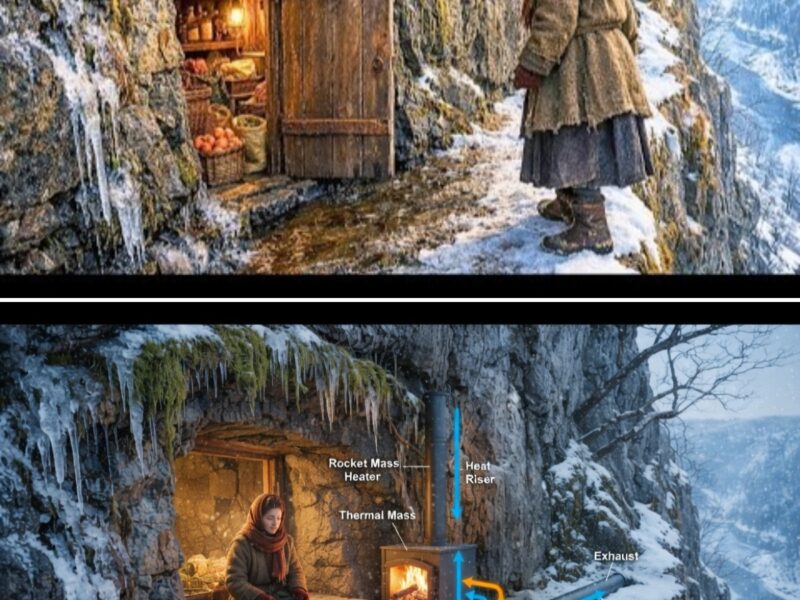
The system, which she thought of as a diare, the Welsh word for earth lung, was not just a flue.
It was a sophisticated heat exchanger, a thermal battery, designed to capture and store energy that was typically thrown away.
The narrative of this story must pause here.
For the principles at work in Alara’s cellar are the hero of this story just as much as she is.
The system she built relied on three core concepts that Silas Blackwood and the town of Redemption, in their log cabin world, had never been forced to consider.
The first concept was thermal mass.
A log cabin, for all its rustic charm and apparent solidity, has remarkably poor thermal mass.
Wood is a decent insulator, but it cannot store a large amount of heat.
When the fire in the stove goes out, the heat stored in the wooden walls radiates away quickly, and the cabin rapidly cools to the ambient outside temperature.
It is a tent made of logs.
The cellar, however, was surrounded by hundreds of tons of earth and rock.
This colossal mass of material was a thermal battery of immense capacity.
It takes a tremendous amount of energy to change the temperature of that much dirt and stone.
This is why the deep earth maintains its steady 55° temperature.
It is a flywheel of thermal energy, smoothing out the violent seasonal swings of the surface.
Alara’s first advantage was that she was not trying to heat a flimsy wooden box.
She was living inside the battery itself.
The second principle was making the smoke pay its rent.
This was the genius of the horizontal flue.
The 30-ft-long, stone-lined tunnel she built was the mechanism for transferring the heat from the smoke into the thermal battery of the earth.
As the hot gases from her small stove traveled through this underground passage, they were in constant contact with the cooler stones.
Through the process of conduction, the heat moved from the smoke to the stones.
Those stones, in turn, conducted their heat into the surrounding soil.
It was a slow, methodical robbery of energy.
The smoke entered the flue at over 400° Fahrenheit, but by the time it reached the small vertical chimney stack 30 ft away, it had been stripped of most of its thermal energy, exiting as a cool, lazy wisp.
All that wasted heat, which in Silas Blackwood’s cabins shot straight up into the sky, was now being injected directly into the earth bank that formed the walls and floor of her living space.
She wasn’t just heating the air in her cellar, she was heating the cellar itself.
The earth around her became a massive, gentle, radiant heater.
The third, and most counterintuitive, principle was the draw.
Blackwood’s objection was logical.
Why would the smoke go down and sideways?
The answer was that the system as a whole still obeyed the laws of physics.
The engine of the draft was not at the beginning of the flue, but at the end.
The final part of her system was a vertical stovepipe, 10 ft tall, that rose from the terminus of the underground tunnel.
Even though the smoke had cooled significantly, it was still warmer, and therefore lighter, than the frigid Dakota air outside.
That final vertical stack, the chimney, was the heart of the engine.
The rising column of air in that pipe created the low-pressure zone that pulled the smoke through the entire 30-ft horizontal section.
It was a weaker draw than a conventional chimney, to be sure, but it was steady and sufficient for her small, efficient stove.
She had, in effect, created a siphon, pulling the heat out of the smoke before it was allowed to escape.
She also incorporated another of Reese’s mining tricks.
Alongside her smoke flue, she buried a smaller, 4-in pipe.
Its intake standing a few feet above the snowpack, and its outlet emerging near the floor of her cellar.
This was her fresh-air supply.
As the cold, dense outside air was drawn into this pipe, it traveled underground, parallel to the warm flue.
The earth, now charged with captured heat, gently pre-warmed this incoming air.
So, instead of the icy drafts that plagued every log cabin in Redemption, pulling frigid air through every crack and Ilera’s cellar was supplied with a constant, slow stream of fresh, preheated air.
It was a closed, balanced system.
A breathing earth lung.
By the first week of December, her system was complete.
She had chinked every stone, sealed every joint.
Her cellar now contained a small bed, a table, and her little pot-bellied stove.
Outside, the temperature had dropped below zero, and stayed there.
The people of Redemption, seeing no smoke from a proper chimney, assumed the mad Welsh widow had either frozen to death, or given up and left.
A few of the more charitable ladies from the church society considered forming a party to check on her, but the first serious blizzard of the season blew in, and kept everyone indoors.
Inside her subterranean haven, Ilera was not just surviving.
She was comfortable.
The small stove barely needed to be fed.
A few small logs, burned slowly with the damper nearly closed, were enough to keep the flue hot and the thermal battery charging.
The stone walls of her cellar, which should have been frigid and damp, were instead radiating a gentle, even warmth.
There were no cold spots, no drafts.
The air was dry and fresh.
She could sit at her table and read Seneca by the light of a single candle, the ambient temperature a steady 60°, while the wind raged outside.
She was using less than a tenth of the wood that a family in a log cabin would burn, yet she was warmer.
She had taken a liability, a damp hole in the ground, and by applying forgotten knowledge, had turned it into an asset of unparalleled efficiency.
The winter deepened.
The old-timers in Redemption admitted they hadn’t seen a December this brutal in 20 years.
The snow piled up in great drifts, isolating the town.
The constant, grinding cold was a thief, stealing firewood, stealing livestock, stealing the very spirit of the people.
Silas Blackwood’s well-built houses were fighting a losing war.
The massive fireplaces, once a point of pride, were now insatiable monsters.
Families were burning through their winter wood supply at a terrifying rate.
They huddled close to the fire, their fronts roasting while their backs froze.
The windows were thick with frost on the inside.
At night, the nails in the roof trusses would contract with the cold, letting out sharp reports like pistol shots.
It was the sound of a shelter under siege.
The true test, the crucible that would reforge the town’s understanding of survival, arrived on the 12th of January, 1888.
History would remember it as the schoolchildren’s blizzard.
It came without warning.
The morning had been deceptively mild, almost spring-like.
But in the early afternoon, the sky dropped like a wall of gray cement.
The temperature plummeted, not by degrees, but by tens of degrees in mere minutes.
A wind of unimaginable ferocity rose out of the north, carrying a blinding, scouring snow that was as fine as flour.
It was not a storm.
It was a physical assault by the atmosphere itself.
In Redemption, chaos reigned.
Children caught walking home from school were lost in the whiteout just yards from their own doors.
Ranchers caught in the open froze [snorts] to death searching for their herds.
The town was plunged into a state of siege, not by an army, but by the sheer physics of absolute cold.
The temperature dropped to 40° below zero, and the wind drove that cold through every crack and seam in the town’s architecture.
In the home of Silas Blackwood, the master builder, the battle was desperate.
He had a wife, Sarah, and two small children, a boy and a girl.
They had already burned through half their winter’s wood in the preceding month.
Now, with the storm at its peak, he was feeding logs into his massive stone fireplace as fast as he could.
The fire roared, a column of flame and heat blasting up the chimney, a frantic sacrifice to the god of the hearth.
Yet the room was freezing.
10 ft from the fire, a cup of water left on the table had frozen solid.
The far walls were coated in a thick layer of crystalline frost.
His children were huddled under a pile of blankets, their faces pale, their breath pluming in the air of their own home.
Silas watched the fire, his face a mask of grim disbelief.
He had built this house with his own hands.
He had used the best logs, the tightest joinery.
He had followed all the rules, all the accumulated wisdom of his trade, and it was failing.
His creation, his fortress against the winter, was proving to be nothing more than a sieve for heat.
A beautifully crafted, but thermodynamically useless box.
He could feel the cold drafts pouring in around the window frames, feeding the fire’s insatiable appetite for air.
His home was actively trying to kill him, sucking in the deadly cold to feed the very fire that was supposed to keep them warm.
The irony was as bitter as the wind.
For two days, the blizzard raged.
The wood pile dwindled.
The cold deepened.
His son developed a hacking cough.
Desperation began to curdle into a primal fear.
And in the depths of that fear, a strange thought surfaced.
The mad Welsh widow, Pritchard’s folly.
He had imagined her frozen solid in her damp hole weeks ago.
It was the only logical outcome.
But what if logic was wrong?
What if her madness held a truth his own rigid expertise could not see?
The thought was an absurdity, but it was a seed.
On the third day, the wind finally abated, though the cold remained, a solid, implacable presence.
His wood pile was nearly gone.
His son was feverish.
Silas Blackwood, the most respected builder in Redemption, a man of pride and certainty, made a decision.
He bundled himself in every layer of clothing he owned, took a shovel, and stepped out into a world of alien white shapes and brutal cold.
It took him over an hour to fight his way through the drifts, his lungs burning with every breath, his beard a solid mass of ice.
He was not going for help.
He did not know what he was going for.
He was simply following the faintest glimmer of an impossible hope.
He found the hawthorn bushes that marked her cellar, now just small humps under a mountain of snow.
There was no sign of life, no smoke.
Of course, he thought, she’s dead.
He had come on a fool’s errand, driven by freezing desperation.
He felt a pang of guilt.
He had mocked her, warned her, and then left her to her fate.
He began to dig at the entrance, not expecting to find a survivor, but perhaps to perform a final grim duty.
After several minutes of frantic digging, he uncovered the top of her simple wooden door.
It was not frozen shut.
He pulled it open, expecting to be met with a gust of deathly cold air, the stillness of a tomb.
Instead, a gentle wave of warm, dry air washed over his face.
He stopped, shovel in hand, utterly confounded.
The air that flowed out of the cellar was warmer than the air in his own house, standing 20 ft from a roaring fire.
It was impossible.
He stumbled down the three short steps into the cellar’s interior, his eyes struggling to adjust to the dim light.
Alara Pritchard was sitting at her small table, mending a tear in her blanket.
Her little stove was giving off a barely perceptible heat, a single small log smoldering within it.
The air was not just warm.
It was fresh.
There was no hint of smoke, no damp chill.
She looked up at him, her expression not of surprise, but of calm expectation.
Silas stood there, a giant of a man caked in snow and ice, his mind struggling to process the sensory information that was dismantling his entire world view.
He looked at the earthen walls, the stone floor.
He reached out a gloved hand and touched the wall beside him.
He had expected it to be freezing, to suck the heat from his fingertips.
But the stone was not cold.
It was neutral.
No, it was warmer than neutral.
It was radiating a faint, almost imperceptible, but undeniable warmth.
He looked from the wall to the tiny stove, then to the pipe that disappeared down into the floor.
He traced the path of her absurd, impossible flue in his mind, the path the heat must have taken.
He saw it now, not as a violation of nature’s laws, but as a clever negotiation with them.
The thermal mass, the heat exchange, the slow, patient capture of energy.
He saw the profound, wasteful foolishness of his own magnificent fireplaces, which were little more than gaping wounds in the envelope of a house, bleeding heat into the sky.
He had come to save a madwoman.
He had found a sage.
His pride, his certainty, the bedrock of his professional identity, crumbled to dust in that warm, quiet space.
He looked at his own half-frozen state, at the memory of his shivering children, and then at this lone woman, perfectly comfortable, sustained by a handful of sticks and a superior idea.
How?
The word came out as a croak, a cloud of frozen breath in the cellar’s warm air.
It was all he could manage.
It was not just a question.
It was a confession.
It was a plea.
Alara did not gloat.
There was no triumph in her eyes, only a deep, weary compassion.
She stood up.
“Your family is cold, Mr.
Blackwood,” she said.
It was a statement, not a question.
“Bring them here.
There is wood enough.
” And so he did.
He trudged back through the snow, a man humbled to his very foundations.
He brought his wife and his two sick children to the widow’s cellar.
They huddled in the gentle, radiant warmth, their shivering slowly subsiding.
Sarah Blackwood looked around the earthen room, at the woman who had been an object of pity and scorn, and saw only a savior.
When the worst of the cold snap finally broke, the town of Redemption slowly came back to life, emerging from their frigid homes to count the cost.
The losses were heavy.
Livestock frozen in their barns, several people dead.
Almost everyone had suffered.
The story of how the Blackwood family had survived, taking refuge in Pritchard’s folly, spread like wildfire.
It was met first with disbelief, then with a reluctant curiosity.
Silas Blackwood became Alara’s first and most devoted student.
He shed his old certainties like a winter coat.
He spent days with her, not talking, but listening.
She showed him Reese’s journal, explaining the principles of the dier, the breathing earth lung.
He, in turn, with his practical builder’s knowledge, began to see ways to improve and formalize the design.
He understood how to properly shore up the earth, how to build with stone and mortar, how to make the system permanent and safe.
That spring, they did not build a new log cabin in Redemption.
They dug one.
With Silas leading the crew and Alara acting as the quiet consultant, they built the first breathing cellar for a family who had lost their home.
They dug into a hillside, constructed a long, stone-lined heat-exchanging flue, and built a modest, but comfortable, subterranean home.
The men who had once mocked her now followed her quiet instructions with a reverent focus.
They had felt the killing cold of a failed idea, and they were desperate for a better one.
Over the next decade, the Welsh method, as it came to be known, revolutionized building in that corner of the Dakota Territory.
The designs became more sophisticated, incorporating passive solar principles with south-facing windows, and incorporating the thermal flue into the foundations of more conventional-looking homes.
But the core idea remained the same, to work with the earth, not against it, to treat heat as a precious resource to be conserved, not a raw power to be wasted.
The houses were warm in the winter, cool in the summer, and astonishingly efficient.
They saved countless lives in the hard winters that followed.
Alara Pritchard lived out her days not as an outcast, but as a respected elder, the quiet matriarch of a new way of thinking.
She never sought recognition, but she earned a quiet reverence that was far more valuable than fame.
Her legacy was not written in books of history, but in the warm, safe homes of the people who had once scorned her.
It was etched in the fundamental principles she had demonstrated, that the most powerful solutions are often found not in fighting nature, but in understanding its systems.
That true ingenuity is often just forgotten wisdom, waiting in a dusty journal or a hole in the ground for a desperate and open mind to rediscover it.
In her later years, she would often sit by her small stove, the heart of her warm, breathing home, and read from Reese’s journal.
One passage in particular she had marked and returned to time and again.
“The mountain does not fight the winter,” he had written.
“It does not rage against the cold.
It simply holds the memory of the sun deep within its stone, and it waits.
” Alara had done more than wait.
She had learned to draw that memory out, to make it her shield.
The smoke had paid its rent.
Heat was not the gift, understanding heat was.
This quiet, revolutionary idea, born in the dark Welsh minds and brought to life by a widow’s desperation in the Dakota hills, became her quiet, enduring triumph.
The world is full of such overgrown entrances, forgotten cellars of knowledge that we walk past every day, dismissing them as folly.
We are taught to build higher, to burn brighter, to fight harder.
But the earth’s long, slow breath offers a different lesson.
What about you?
What forgotten knowledge lies dormant in your own legacy?
What simple, elegant solution is hiding in plain sight, dismissed by conventional wisdom as a hole in the ground?
Your cellar is waiting.
Start digging.
This story is a historically inspired reconstruction.
The characters and specific events are fictional, created for the purpose of illustrating principles of resilience and ingenuity.
The content does not constitute professional architectural, engineering, or survival advice.
Always consult with qualified professionals for any building or survival needs.
What if 88 U.S. Army Rangers had only 90 minutes to drag an IRGC
What if 88 U.S. Army Rangers had only 90 minutes to drag an IRGC
A-10 Warthog — the legendary tank-killing beast — just got hit hard over the Middle East
A-10 Warthog — the legendary tank-killing beast — just got hit hard over the Middle East
American troops die in combat zones
Golan Heights: Israel’s Legendary Tank Defence Against Syria | Greatest Tank Battles | War Stories
Golan Heights: Israel’s Legendary Tank Defence Against Syria | Greatest Tank Battles | War Stories
Golan Heights: Israel’s Legendary Tank Defence Against Syria | Greatest Tank Battles | War Stories
https://online.tinxahoivn.com/thinh4/golan-heights-israels-legendary-tank-defence-against-syria-greatest-tank-battles-war-stories/
21-YEAR-OLD AIRBORNE BEAUTY RIPPED TO SHREDS IN ‘SAFE’ TRAINING JUMP – FORT BRAGG BLOODBATH EXPOSES ARMY’S DEADLY LIES!
Saudi & UAE Build “$200B Mega Canal” to ENDS Iran’s Strait of Hormuz Route
Saudi & UAE Build “$200B Mega Canal” to ENDS Iran’s Strait of Hormuz Route
Iran Just LOST Control of Missiles… U.S. Just Did Something HUGE to STRANDED It
Iran Just LOST Control of Missiles… U.S. Just Did Something HUGE to STRANDED It
It ALL Started with Ukrainians Entered M14 Highway… Now 60,000 Russians Are Desperately STRANDED
It ALL Started with Ukrainians Entered M14 Highway… Now 60,000 Russians Are Desperately STRANDED
The Unthinkable Just Happened in Iran… Coup Against Iranian Supreme Leader
The Unthinkable Just Happened in Iran… Coup Against Iranian Supreme Leader
Ukraine Did Something to END Iran’s Strikes… Even the U.S. Didn’t Expect This Much
Ukraine Did Something to END Iran’s Strikes… Even the U.S. Didn’t Expect This Much
Mega Tunnels of Iran Have Been Collapsed! Secret Materials STRANDED Underground
Mega Tunnels of Iran Have Been Collapsed! Secret Materials STRANDED Underground
100 Million People Faces “ZERO DAY”, Evacuation as Iran Threatens Gulf Water Plants
100 Million People Faces “ZERO DAY”, Evacuation as Iran Threatens Gulf Water Plants
Houthis Join Iran to SHUTS DOWN Double Straits… US Unleashes Something MASSIVE to Open It
Houthis Join Iran to SHUTS DOWN Double Straits… US Unleashes Something MASSIVE to Open It
Secret Mega Plant of Iran Have Been Collapsed! Hundreds of Missiles Vaporized Underground
Secret Mega Plant of Iran Have Been Collapsed! Hundreds of Missiles Vaporized Underground
Silent GIANT Just Entered the War… U.S. BIG Surprise for Iran
Silent GIANT Just Entered the War… U.S. BIG Surprise for Iran
Moscow’s Kaliningrad Land Bridge Is Gone—Millions Panic as St. Petersburg Port Bridges SHUTS DOWN
Moscow’s Kaliningrad Land Bridge Is Gone—Millions Panic as St. Petersburg Port Bridges SHUTS DOWN
U.S. Just Did Something BRUTAL To Rescue F-15 Pilots… Now IRGC’s Trap BACKFIRED
U.S. Just Did Something BRUTAL To Rescue F-15 Pilots… Now IRGC’s Trap BACKFIRED
Cops Rescue 7 Children After Disturbing Traffic Stop
Wandering Toddler Leads Police to His Irresponsible Mom
Wandering Toddler Leads Police to His Irresponsible Mom
https://online.tinxahoivn.com/thinh4/wandering-toddler-leads-police-to-his-irresponsible-mom-3/
Wandering Toddler Leads Police to His Irresponsible Mom
https://online.tinxahoivn.com/thinh4/wandering-toddler-leads-police-to-his-irresponsible-mom-2/
Wandering Toddler Leads Police to His Irresponsible Mom
ICE ARREST 1500+ Illegal Alien’s Anti Trump Protest – 1.3 Tons Drugs Caught!
ICE ARREST 1500+ Illegal Alien’s Anti Trump Protest – 1.3 Tons Drugs Caught!
the legendary “Big Red One”
The loss of five Big Red One Soldiers who died in Iraq
They Laughed at Her Tattoo in SEAL Training — Then They Froze When the Commander Saluted Her
They Laughed at Her Tattoo in SEAL Training — Then They Froze When the Commander Saluted Her
Hijackers Took Over the Flight—The “Flight Attendant” Was a Decorated Combat Pilot
Hijackers Took Over the Flight—The “Flight Attendant” Was a Decorated Combat Pilot
They Arrested Her for Impersonating a SEAL — Until the General Noticed, “Only Operators Carry That ”
They Arrested Her for Impersonating a SEAL — Until the General Noticed, “Only Operators Carry That ”
Enemy Migs Intercepted The Airliner—The ‘Civilian Pilot’ Was A Top Gun Instructor
Enemy Migs Intercepted The Airliner—The ‘Civilian Pilot’ Was A Top Gun Instructor
Most US Soldiers never talk about what they saw in Iran.
“Don’t… It Still Hurts There”—The Giant Apache Girl Said The Lone Rancher
“Don’t… It Still Hurts There”—The Giant Apache Girl Said The Lone Rancher
Trapped By A Blizzard, The New Teacher Accepted A Giant Cowboy’s Bold Offer
Trapped By A Blizzard, The New Teacher Accepted A Giant Cowboy’s Bold Offer
9 Important Differences in Men’s and Women’s Health Care Everyone Should Know
9 Important Differences in Men’s and Women’s Health Care Everyone Should Know
They Told Her She’d Work the Fields, Not the House But the Cowboy Said You’ll Do Whatever You Choose
They Told Her She’d Work the Fields, Not the House But the Cowboy Said You’ll Do Whatever You Choose
You Might Not Be Able to Walk After This Kiss – Wild West Revenge Turned Passionate Love Story! 🤠🔥
You Might Not Be Able to Walk After This Kiss – Wild West Revenge Turned Passionate Love Story! 🤠🔥
Dead Man’s Hand: The True Story of Wild Bill Hickok
Apache Woman Closed Her Eyes to Die—But Woke Up in a Cowboy’s Bed Instead! – Wild West Story
Apache Woman Closed Her Eyes to Die—But Woke Up in a Cowboy’s Bed Instead! – Wild West Story