A Pregnant Widow Gave Shelter to an Old Couple — What She Discovered Changed Everything
The iron skillet smelled of yesterday’s rabbit grease and something older.
The particular musk of a house that had known grief and learned to live inside it.
Mara Callaway stood at the stove in her d*ad husband’s wool socks because the floorboards near the window had warped in the spring thaw and splinters found bare feet like they had a personal grudge.
Outside, the wind came down off the Broken Tooth Ridge in long mournful pulls rattling the single glass pane she hadn’t yet replaced with oilskin for winter.
Seven months gone with child and she still hadn’t replaced the glass.
There were only so many hours in a day a woman could divide between survival and grief before one of them started losing.
The knock, when it came, was not the knock of someone confident they’d be welcomed.
It was small, almost apologetic.
Two taps, like a question asked by someone who already expected the answer to be no.
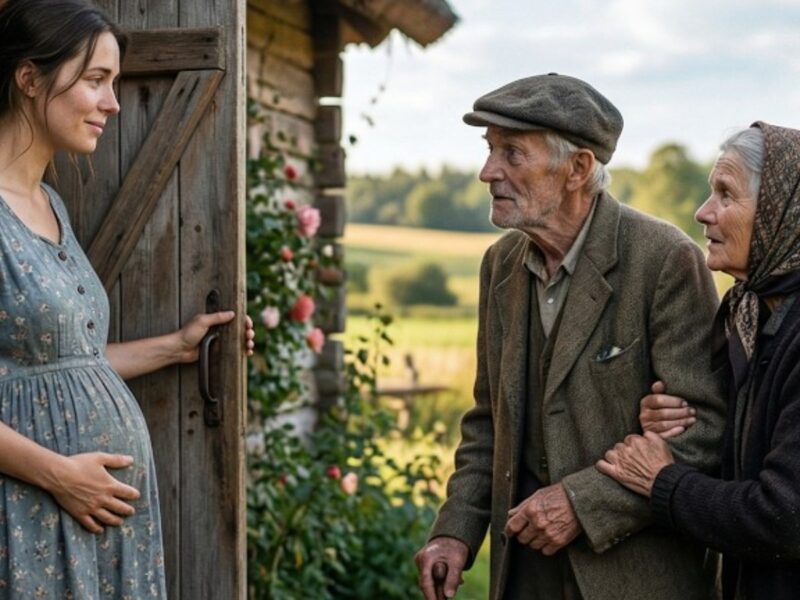
Mara wiped her hands on the flour sack she used as an apron and moved toward the door the way she moved everywhere now, with her left hand braced at the small of her back, her belly leading like a lantern held out in front of her into the dark.
She unhooked the latch.
The wind punched through before the door had swung half open.
An old man stood on her porch step.
Behind him, half a step back and gripping his coat sleeve with both thin hands, a woman so small the wind seemed to be considering whether to take her.
“Beg pardon, missus.” The old man said.
His hat was the color of river mud and appeared to be losing an argument with its own brim.
“We don’t mean to impose on your evening.
Name’s Gideon Pratt.
This here is my wife, Ula.
Our wagon threw a wheel about a mile east on the Sorrow Creek road, and the cold He stopped.
Looked at her belly with the practiced discretion of an older man, the kind that has witnessed enough of life to recognize it in all its inconvenient forms.
We won’t stay but one night, if you’ll allow.
Mara looked at Ula Pratt.
The woman’s lips had gone the faint blue of creek ice.
Her eyes were the pale amber of old glass, and they held something beyond cold.
A watery distant expression that Mara recognized the way you recognize a song you haven’t heard since childhood.
She’d seen that look in the mirror every morning for 4 months.
She stepped back.
Come in.
She did not think about whether it was wise.
She thought about coffee, and whether she had enough dried venison for three, and whether the second blanket stored in the cedar chest still smelled of cedar, or only of the man who used to wrap it around his shoulders on winter mornings while he read aloud from whatever book he’d borrowed from the mercantile in Dunmore Flats.
She did not let herself finish that thought.
Gideon helped Ula inside with the unhurried tenderness of someone who had been doing this particular thing, steadying this particular woman, for so long it had become the organizing principle of his entire body.
He did not hold her arm.
He simply adjusted his own weight so she could use him however she needed to.
Mara noticed this.
She noticed small things now in a way she hadn’t before Thomas d*ed.
Grief had sharpened her vision for the details that mattered.
She settled them by the stove.
Ula’s hands, when they wrapped around the tin cup Mara pressed into them, were mapped with veins as pronounced as river tributaries.
And there was ink.
Old ink, long faded, stained into the webbing between her right thumb and forefinger.
The hands of a woman who had once written things down.
Mara found herself staring and looked away.
“You’re from west of here.” Mara said.
Not a question.
She’d heard the particular cadence of country west of the Osler mountains in the old man’s vowels.
Gideon settled into the chair near the stove, Thomas’s chair, the one with the cracked leather armrest.
And if he noticed the way Mara’s jaw tightened for a half second, he gave no sign.
“Harlow Basin, originally?” “Been moving east these last 3 weeks.” “Moving toward something or away from it?” He smiled then.
Not wide.
Just a small rearrangement of deep creases around his mouth.
“Ma’am, at my age, those two things have a way of being the same.” Yula said nothing.
She drank her coffee in small sips, her eyes moving around the room the way eyes move when they are cataloging rather than merely seeing.
She looked at the r*fle above the door.
She looked at the mended curtain, the stitching mismatched because Mara had run out of the original thread and used what she had.
She looked at the row of three books on the shelf above the window.
A farming almanac, a Bible with a cracked spine, and a thin, water-damaged volume of Tennyson.
And her pale amber eyes lingered there just a moment too long.
That night, Mara lay in the dark listening to the house breathe around its two guests.
The baby moved.
A long slow roll that pushed against her ribs from the inside.
And she pressed her palm flat against her side and waited until the movement stilled.
She thought about Thomas.
Not the way she usually thought about him, which was involuntary and brutal, like walking into a door you’d forgotten was there.
She thought about him deliberately, which she almost never allowed herself to do, because deliberately meant choosing it.
And choosing it meant she had some say in her own suffering.
And she was not yet certain she believed that.
He had been a man who whistled off key while he worked.
He had kept every letter ever sent to him in a cigar box under the bed.
He had d*ed in October of a fever that took him in 11 days.
Sudden and total and almost insultingly ordinary, as if the universe had simply lost interest and moved on to other business.
She had not opened the cigar box since.
In the morning, Eula was already awake when Mara came out of the bedroom.
She was sitting at the kitchen table with the thin Tennyson volume open in front of her and she was not reading it.
She was looking at the inside front cover.
Mara stopped.
She knew what was written there.
She knew it the way she knew the sound of her own heartbeat without having to listen for it, just as a fact of her body’s continued functioning.
Thomas had written it.
A quotation in his large looping hand, the hand of a man who had learned penmanship from someone who took it seriously.
I am a part of all that I have met.
Eula’s finger rested on the words without touching them, like someone standing at the edge of something they were not sure they had the right to enter.
“That was my husband’s book,” Mara said.
Her voice came out quieter than she intended.
Eula looked up.
In the morning light, without the emergency of cold making her face tight and closed, she looked different.
Older, but somehow more present.
The amber eyes were clear and direct.
“I know,” she said.
“Thomas Callaway.
He was my son.” The iron skillet on the stove began to spit.
The coffee water had boiled over without Mara noticing, and the drops were hitting the hot iron in sharp, furious little hisses, each one a small erasure of the silence.
Mara sat down.
She sat down because her legs asked her to, and she had long since learned to listen to her body’s requests.
She sat across from this woman, this stranger, this not stranger, and looked at the face she should have recognized, would have recognized if grief hadn’t worn her vision down to the purely practical, the near and the immediate and the necessary.
Thomas had his mother’s eyes.
She had known Eula existed.
Thomas had spoken of his parents with the cautious, abbreviated tenderness of someone describing a wound that had healed, but left the skin strange.
They had parted badly.
Something about land, about money, about the particular cruelty that only families can manage because only families know precisely where to aim.
He had written to them.
She knew that much.
The cigar box under the bed, the one she hadn’t opened.
He wrote to us, Gideon said from the doorway.
He had been standing there long enough that she suspected he had watched her realize it.
He was carrying his hat in both hands, turning it by the brim in a slow circle.
The way men hold their hats when they are holding something they cannot otherwise hold.
“Every few months,” he wrote.
We wrote back, but never We were too proud for too long.
By the time we weren’t “He was gone,” Mara said.
Yes.
The wind had dropped overnight.
The morning was very still.
From outside came the sound of a single bird, some hardy winter species she didn’t know the name of, working through a short repeated sequence of notes as though trying to remember the rest of a song.
Mara thought about what it cost two old people to climb into a wagon and drive three weeks across hard country in autumn.
She thought about a thrown wheel on the Sorrow Creek Road, a mile east in the exact direction you’d come from if you’d been to the land records office in Dunmore Flats looking for a Callaway claim.
She thought about how they had knocked like people who expected the door to stay shut.
She stood up slowly and went to the stove.
And she did what she always did when the world became too large for a moment.
She made herself useful in the smallest possible way.
She moved the skillet.
She poured the boiled over water off the eye.
She added wood and watched the flame catch.
“Thomas talked about you,” she said with her back to them because some things are easier to say in profile.
He He his mother had the best instincts of anyone he’d ever met.
That she could look at a piece of land and tell you in 5 minutes what it would and wouldn’t grow.
He said his father could fix anything made of wood or iron.
She paused.
He said he wished things had been different.
The silence behind her was the particular kind that happens when people are trying very hard not to make a sound because any sound might break something fragile and necessary.
He told you that?
Eula’s voice had changed register.
Lost its careful, measured quality.
He told me a lot of things.
Mara turned around.
He was a man who believed in saying things while you still could.
She looked at Eula Pratt, at Eula Callaway she supposed, at the woman who had looked at her d*ad husband’s book the way you look at a piece of a person you thought you’d never see again.
And she felt something move through her that was not quite grief and not quite relief and not quite hope but shared a border with all three.
The baby moved again.
A sharp, sudden pressure against her lowest rib, insistent and entirely without patience for the emotional complexities of adults.
Eula saw it.
The small flinch, the automatic hand to the side.
She stood up from the table with the careful deliberateness of a woman who has earned every movement.
And she crossed the kitchen.
And she put her ink-stained hand over Mara’s hand where it rested against the curve of her belly.
She did not say anything.
There was nothing to say that the gesture didn’t already contain.
Gideon cleared his throat.
The wagon wheel,” he said, with the transparent practicality of a man retreating to logistics because the emotional weather has exceeded his tolerance.
“I can fix it today if you have a spare iron band and a draw pin.
I noticed your fence posts on the south side need resetting.
The ground heaved in the frost.” He turned his hat one more slow revolution.
“We don’t have anywhere particular to be before spring.” Mara looked at this old man in his river mud hat offering himself and his labor to a daughter-in-law he’d never met in the house of a son he’d never had the chance to apologize to.
She thought about the winter coming down off the Broken Tooth Ridge.
She thought about the baby arriving in February or thereabouts into a house with no second pair of hands.
She thought about the cigar box under the bed full of letters that traveled in both directions, full of words that had crossed the distance too slowly to matter while Thomas was living and might matter enormously now that he was not.
“The spare iron bands in the barn,” she said.
“South wall, hanging on the third hook.” She turned back to the stove.
Outside, the single bird had found the rest of its song and was running through it now, full and unhesitating, as if it had simply needed a moment to remember how it went.
The coffee pot began to rattle with heat.
The kitchen filled with the smell of it, dark and bitter and necessary.
And Mara Callaway stood in her d*ad husband’s wool socks on the warped floor of the house they had built together carrying the child he would not live to meet.
And she did not look at the horizon.
She looked at the table set now for three and she thought about what it meant to be handed back a piece of something you had believed completely lost.
It didn’t fill the absence.
Nothing would.
But it settled against it, the way a warm stone settles into cold ground.
Slowly, and with a kind of permanence that the cold has no argument against.